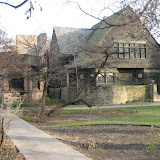
A walking tour (which included an ipod guide) was very educational. You my browse some of the pictures I took in this tour of houses he commissioned. The best part of the tour however was visiting the inside of his home and studio. The home had been converted to a boarding house during his divorce years with his first wife but it has now been restored to much of its original form.
Frank’s Early Years
Frank Lloyd Wright was born in the agricultural town of Richland Center, Wisconsin, United States, on June 8, 1867, just two years after the end of the American Civil War. He was brought up with strong Unitarian and transcendental principles (eventually, in 1905, he would design the Unity Temple in Oak Park, Illinois). As a child he spent a great deal of time playing with the kindergarten educational blocks by Friedrich Wilhelm August Froebel (known as Froebel Gifts) given to him by his mother. These consisted of various geometrically shaped blocks that could be assembled in various combinations to form three-dimensional compositions. Wright in his autobiography talks about the influence of these exercises on his approach to design. Many of his buildings are notable for the geometrical clarity they exhibit.
Wright's home in Oak Park, Illinois
Wright began his formal education in 1885 at the University of Wisconsin-Madison School for Engineering, where he was a member of a fraternity, Phi Delta Theta. He took classes part-time for two years while apprenticing under Allan Darst Conover, a local builder and professor of civil engineering. In 1887, Wright left the university without taking a degree (although he was granted an honorary doctorate of fine arts from the university in 1955) and moved to Chicago, Illinois, where he joined the architectural firm of Joseph Lyman Silsbee. Within the year, he had left Silsbee to work for the firm of Adler & Sullivan. Beginning in 1890, he was assigned all residential design work for the firm. In 1893, Wright was fired from Adler & Sullivan by Louis Sullivan himself, after Sullivan discovered that Wright had been accepting clients independently from the firm. Wright established his own practice and home in the Chicago suburb of Oak Park, IL. He had completed around fifty projects by 1901, including many houses in his hometown.